
Cambridge Pavers General Contractor in Daly City: A Homeowner’s Guide
Cambridge Pavers carry a lifetime residential warranty, but that warranty doesn’t cover settling caused by improper base preparation. On Daly City’s clay-heavy, sloped lots, that’s the single most common failure mode we see. If you’re planning a paver patio, walkway, or driveway in Daly City and want a straight answer on what it takes to get a Cambridge installation that lasts 20 years instead of 4, you’re in the right place. And if you’d rather skip the research and just talk to someone who installs them, call (866) 505-5254.
Why Cambridge Pavers Are Worth the Investment in Daly City
Cambridge Pavers are manufactured in New Jersey using a high-density concrete blend that produces a compressive strength around 8,000 PSI. That’s roughly double what you’ll find in big-box store pavers. For Daly City homeowners, that strength matters because our wet winters and marine-layer moisture create freeze-thaw cycles that crack cheaper pavers within a few seasons. Cambridge’s interlocking design also handles lateral movement better than rectangular pavers laid in a running bond, which helps on sloped lots where soil creep is a constant factor.
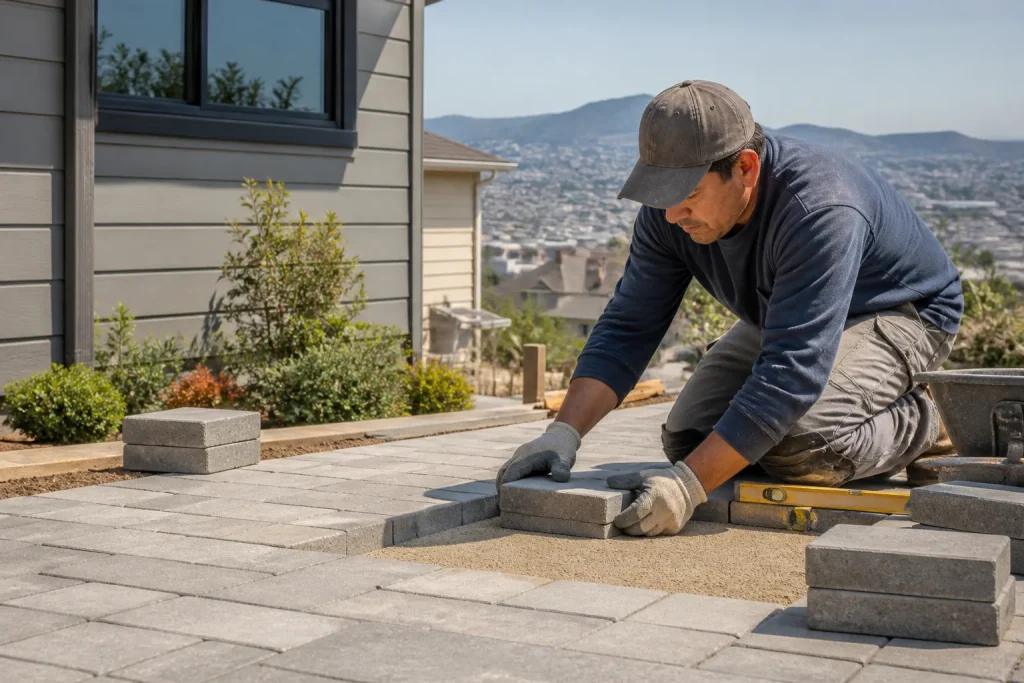
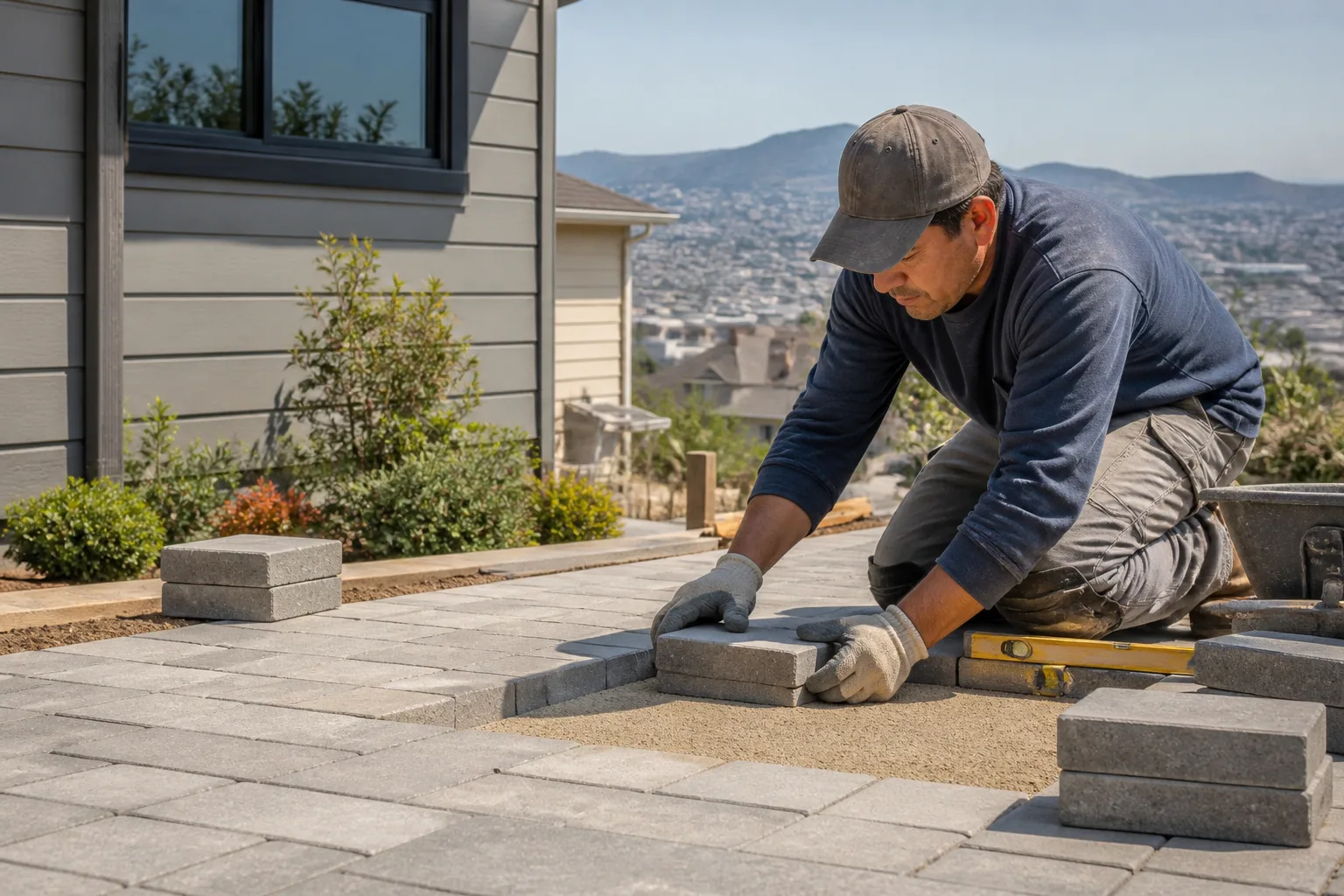
But here’s the thing most homeowners don’t realize: the product is only half the story. A Cambridge paver field installed over a poorly compacted base on Daly City’s expansive clay will shift, heave, and sink no matter how good the paver itself is. We’ve torn out paver patios in the home remodeling neighborhoods around Westlake and Serramonte where the pavers were still in perfect shape, but the base had settled 3 inches in two years. The pavers went to the dump, not because they failed, but because nobody bothered to prepare the subgrade properly.
Daly City Soil Conditions: The Base Spec No One Talks About
Daly City sits on a mix of marine sedimentary rock and expansive clay soils. The clay swells when wet and contracts when dry, which creates vertical movement in anything sitting on top of it. Cambridge’s standard installation spec calls for a 6-inch aggregate base under pedestrian pavers and 10 to 12 inches under driveways. On Daly City clay, we treat those as minimums, not recommendations.
Here’s what we spec for Daly City conditions:
- Geotextile fabric between the native soil and the aggregate base to prevent clay from migrating up into the stone
- 8 to 10 inches of compacted aggregate base for patios and walkways, not the 6 Cambridge shows on standard spec sheets
- 12 to 14 inches for paver driveways, with the aggregate compacted in 3-inch lifts using a plate compactor, not a hand tamper
- Polymeric sand or gravel joint fill rated for high-moisture environments to keep water from washing fines out of the joints
If you’re interviewing contractors, ask them directly: “What’s your base depth spec for clay soil in Daly City?” If they say 6 inches for a patio and don’t mention geotextile fabric, keep looking. We’re a general contractor in Daly City who handles hardscaping as part of larger projects, and we see this mistake on pavers installed by specialty hardscape crews who work off the manufacturer’s national spec sheet instead of local soil reality.
Drainage and Slope Design for High-Fog, High-Moisture Paving
Daly City gets about 25 inches of rain annually, but the bigger issue is the persistent fog and condensation. Paver surfaces stay damp for weeks at a time, and standing water on a poorly graded patio becomes a slip hazard and a breeding ground for moss and algae. Cambridge pavers with a smooth surface profile are particularly slick when mossy, which is why we specify a textured paver for any shaded area.
For drainage, the rule is simple: positive cross-slope, always. Here’s what we design to:
- Paver patios: 1.5% to 2% slope away from the house (that’s roughly 3/16 to 1/4 inch per foot)
- Paver driveways: min 1% cross-slope, 2% preferred on Daly City hillside lots
- Walkways: 1% cross-slope, plus a 2% crown if the walkway is wider than 5 feet
- Channel drains or French drains at the low point of any paver field that runs more than 20 feet toward the house
On sloped lots, we also recommend retaining edges. A paver patio cut into a hillside in the home renovation zones up toward the Cow Palace needs a block or concrete restraint along the downhill edge, or the pavers will slowly creep toward the street. It’s a small detail that most homeowners never think about until their patio starts walking away one rainy winter at a time.
Cambridge Product Lines: Which Ones Hold Up on Daly City Driveways vs. Patios
Cambridge makes several paver collections, each with different surface textures, thicknesses, and recommended applications. Here’s how we think about them for coastal California conditions:
- Ledgestone Collection: Linear, flagstone-style pavers with a textured surface. Great for garden patios and pool decks where you want a natural look. The texture helps with slip resistance in foggy weather. We’d avoid it for driveways; the longer pavers can crack under vehicle load if the base settles even slightly.
- Cambridge Tumbled Collection: Pavers with slightly rounded edges that look like old European cobblestone. The joints between tumbled pavers need real attention to polymeric sand because the irregular edges leave wider gaps. Good for patios and walkways in traditional Daly City homes. Not our first pick for a driveway.
- Cambridge Holland and Interlocking styles: Smaller pavers with tight joints. These are the workhorses for driveway applications because the interlocking pattern distributes vehicle weight well and the smaller units flex less under load.
For most Daly City projects, we spec a Cambridge interlocking or Holland-style paver for driveways, and the Ledgestone or Tumbled line for patios and garden walks. The difference in pricing between lines is modest, but the performance difference on a sloped driveway is significant. We’ve pulled out Tumbled pavers from driveways that had fractured along the high point where the vehicle wheels loaded the edge of each unit.
Authorized Contractor vs. Supply House Installer: What Actually Matters
Cambridge operates an authorized contractor program, which means installers complete manufacturer training on base prep, edge restraint, joint fill, and paver pattern layout. An authorized installer also has direct access to Cambridge’s field reps for product issues and warranty claims.
A generic hardscape contractor can buy Cambridge pavers at any building supply distributor. They know how to lay blocks. That’s the problem. The difference shows up in the details:
- Base prep: An authorized installer specs the subgrade correctly for the local soil and the application. A supply-house crew uses a one-size-fits-all formula.
- Edge restraint: Authorized training covers edge restraint that’s pinned to the base, not just buried in soil. On a Daly City slope, unpinned edges fail within the first winter.
- Joint fill: The right polymeric sand, activated correctly and topped off properly, keeps the pavers from shifting and the joints from growing weeds. A rushed installer skips the second activation.
- Warranty support: If a paver does fail, an authorized contractor has a direct channel to Cambridge for a product warranty claim. A homeowner dealing with a supply-house installer might be stonewalled.
Daly City Construction sources Cambridge Pavers through authorized distribution, and we treat the manufacturer’s training requirements as a floor. Our take: the paver is a quality product, but the installation spec is what you’re actually paying for. If you’re planning home remodeling in Daly City that includes a paver patio or driveway, ask your contractor for proof of their Cambridge authorization and their base prep spec in writing.
Sequencing a Cambridge Paver Project with Fencing, Grading, or an ADU
Most paver failures we see on Daly City lots aren’t from the pavers or the base. They’re from someone running a skid steer over a finished paver field to build a fence, or from a later grading project that sends runoff pouring into the paver joints. If your project includes a paver patio plus adjacent work, sequence matters.
Here’s the order we follow on multi-trade jobs in Daly City:
- Site grading and drainage infrastructure first. If you’re installing channel drains, French drains, or re-grading the lot, that happens before a single paver goes down.
- Fencing and retaining walls next. Fence posts get set before pavers go in around them. Trying to auger a fence post through a finished paver field means cutting pavers, patching the base, and living with a seam. Retaining walls get their footings poured and backfilled before the paver base goes in, so the paver edge can tuck under the wall cleanly.
- ADU or prefab foundation work third. If you’re adding an ADU from a partner like Boxabl or Plant Prefab, or even a Tuff Shed for storage, the foundation and utility trenchers get completed before pavers go in. Construction equipment, concrete trucks, and paver fields don’t mix. We schedule paver work after the heavy machinery is done on site.
- Paver base and pavers last. The pavers are the final surface. They’re what you see every day, so they go in after the messy work is complete.
The project we pulled out of a garage over in Broadmoor last month was a paver patio that had been installed first, then a fence contractor came through and ran a post-hole digger right through the middle of the field. The homeowner had paid for the paver work, then paid to repair it. Sequence matters.
When to call a pro: If your paver project sits on a slope steeper than 5%, involves a driveway, or is part of a larger remodel with fencing, grading, or an ADU, call someone who’s handled the full project scope before. A paver-only contractor won’t think about the fence posts or the foundation trenching, and you’ll pay for the oversight later.
Related services in Daly City: We handle hardscaping as one trade within full-scope home renovation in Daly City, which means your paver patio, fence, and ADU foundation are all scheduled, graded, and installed by one crew with one point of accountability.
The Bottom Line
Cambridge Pavers are a quality product with a strong warranty, but on Daly City’s clay-heavy, sloped, fog-damp lots, the installer’s base spec and drainage design matter more than the paver itself. Ask for proof of Cambridge authorization, get the base depth and geotextile fabric spec in writing, and sequence the paver work after fencing, grading, and foundation work is complete. If you’re planning a Cambridge paver patio, walkway, or driveway in Daly City and want a straight answer on what your project needs, Daly City Construction offers free estimates. Call (866) 505-5254.
Frequently Asked Questions
A Cambridge paver patio in Daly City generally falls in the $35 to $60 per square foot range installed, depending on slope, base depth, and the product line you choose. Driveways run higher because of the thicker aggregate base and heavier paver specification. The best way to price your specific lot conditions is with a site visit. Call (866) 505-5254 for a free estimate, and we’ll walk the site with you.
Yes, with the right base spec and edge restraint. Cambridge interlocking pavers handle sloped driveways well when the base is deepened for clay soil, compacted properly, and restrained with pinned edges. The pavers that fail on sloped driveways in Daly City are almost always sitting on an undersized base. Call (866) 505-5254 if you’d like us to evaluate your specific lot.
With proper base prep for clay soil and correct drainage, a Cambridge paver field should last 20 to 30 years in Daly City. With a 6-inch base on expansive clay and no geotextile fabric, expect visible settling within two to four winters. The paver isn’t the variable; the installer is.
Most residential paver patios and walkways don’t require a permit in Daly City, though paver driveways that change the footprint or tie into a city sidewalk may require a simple grading or encroachment review. We recommend calling the city’s building department or asking your contractor to verify before work begins. Daly City Construction handles permitting on any project that needs it.
Written by the team at Daly City Construction, serving Daly City since 2013.
Need Construction Help?
Call Daly City Construction — licensed & insured, here with fast after-hours help in Daly City.
(866) 505-5254