
Emergency General Contractor Near Me: What Daly City Homeowners Should Do First
In a construction emergency, the first 60 minutes determine whether you have a clean insurance claim and a stabilized home, or a denied claim and compounding damage. The correct sequence is: shut off the relevant utility, photograph everything, contain the water, then call your insurer and a licensed General Contractor in Daly City. Most homeowners do this in reverse. They call a contractor, wait two hours for someone to arrive, and only then start documenting, by which point the damage has spread and the evidence has degraded.
We’ve walked into homes in the Westlake and St. Francis Heights neighborhoods where a burst supply line ran for an hour before anyone thought to turn the water off at the street. That hour cost the owner an extra $8,000 in drywall, insulation, and framing replacement. If you’d rather not manage this yourself, call us at (866) 505-5254. But read the rest of this first, it will save you money either way.
Step 1: Shut Off the Correct Utility, in the Correct Order
The utility shutoff sequence changes depending on the emergency. Doing it wrong can create a second emergency. Here’s what applies to the three most common Daly City home failures: roof breaches with interior water intrusion, foundation wall cracks with active movement, and post-storm retaining wall failures.
For a roof breach or any water intrusion from above: kill the electricity at the main breaker first, unless the water is already flowing through or near the panel, in which case call PG&E and do not enter the room. Water and live electrical circuits are a genuinely dangerous combination. Every year we see homes where a homeowner flipped a soaked light switch and took a shock they were lucky to walk away from. After the breaker, shut off the main water valve at the street or at the house’s main shutoff, usually located near the water heater or in the garage. This prevents a secondary leak if the storm has also stressed a supply line.
For a foundation wall crack with active movement: shut off the gas at the meter, because lateral movement can shear gas lines where they enter the foundation. Then shut off the water. Do not enter a basement or crawlspace if you smell gas or see obvious structural displacement. Evacuate and call the utility company from outside. In Daly City, our hillside lots mean foundation movement is often slope-related, and the safest call is a structural assessment before anyone re-enters.
For a post-storm retaining wall failure: shut off water and gas if the wall is retaining earth near the house’s lines. Erosion behind the wall can expose and damage buried utilities. Keep at least 20 feet of clearance from the wall’s top edge. A wall that has failed once will keep moving during the same storm cycle, and falling wet earth is heavier than people expect.
The pattern here is simple: electricity first, then gas, then water. Write it down and tape it inside a kitchen cabinet. In a real emergency, you won’t remember it from a blog post.
Step 2: Photograph and Document in the First 30 Minutes
Insurance adjusters work from evidence, not from descriptions. The documentation you gather in the first half hour is the single largest factor in whether your claim is paid in full. Here’s what homeowners routinely miss:
- Wide shots with a reference object: Photograph every affected room from the doorway, with a quarter, a tape measure, or a standard sheet of paper placed in the frame. Without a scale reference, adjusters cannot confirm the extent of the damage, and they will assume the smaller interpretation.
- Close-ups of the point of failure: The exact shingle that lifted, the exact crack in the wall, the exact joint where the retaining wall separated. These photos prove causation. Without them, the insurer may attribute the damage to pre-existing conditions.
- The utility shutoff positions: Photograph the breaker panel with the main thrown, the gas meter valve closed, the water main closed. This proves you acted to mitigate further damage, which is a condition of virtually every homeowner’s policy.
- Timestamps on everything: Use a phone that stamps time and date automatically. If yours doesn’t, hold up a second phone or watch showing the time in each photo. The sequence of photos should tell a timeline.
- Moisture meter readings if you have one: A $35 pin-type moisture meter from any hardware store is one of the best insurance investments a homeowner can make. Reading the affected drywall and framing gives the adjuster objective data. Write the readings on painter’s tape and place the tape in the photo.
Never begin any cosmetic repair, removal, or cleanup that alters the scene before photographing it. This includes pulling up wet carpet. You can extract standing water with a pump or wet vac, but leave the damaged materials in place until the adjuster has documented them. If you’re in Daly City and dealing with a claim, we’re happy to walk you through what to photograph before our crew arrives for any stabilization work. This is one of the areas where a Home Remodeling in Daly City contractor with experience across roof, structural, and interior scope can save you from a denied claim.
Step 3: Separate Emergency Stabilization from Permanent Repair
Emergency stabilization and permanent repair are two different jobs, with two different timelines, two different scopes, and two different permitting requirements. Mixing them up is the most expensive mistake a Daly City homeowner can make after the initial emergency passes.
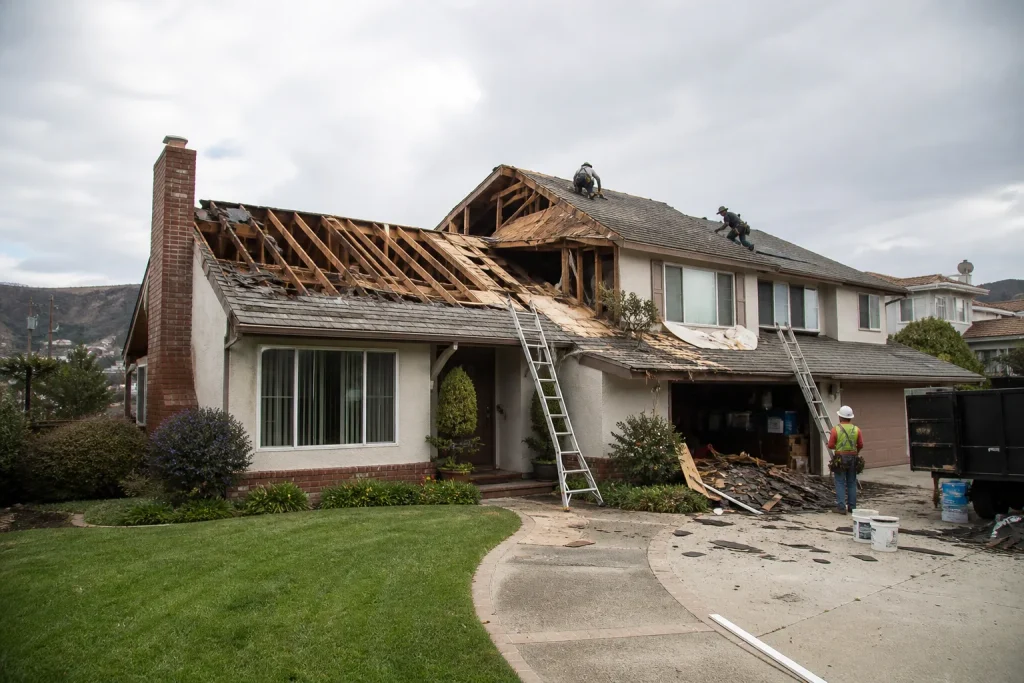
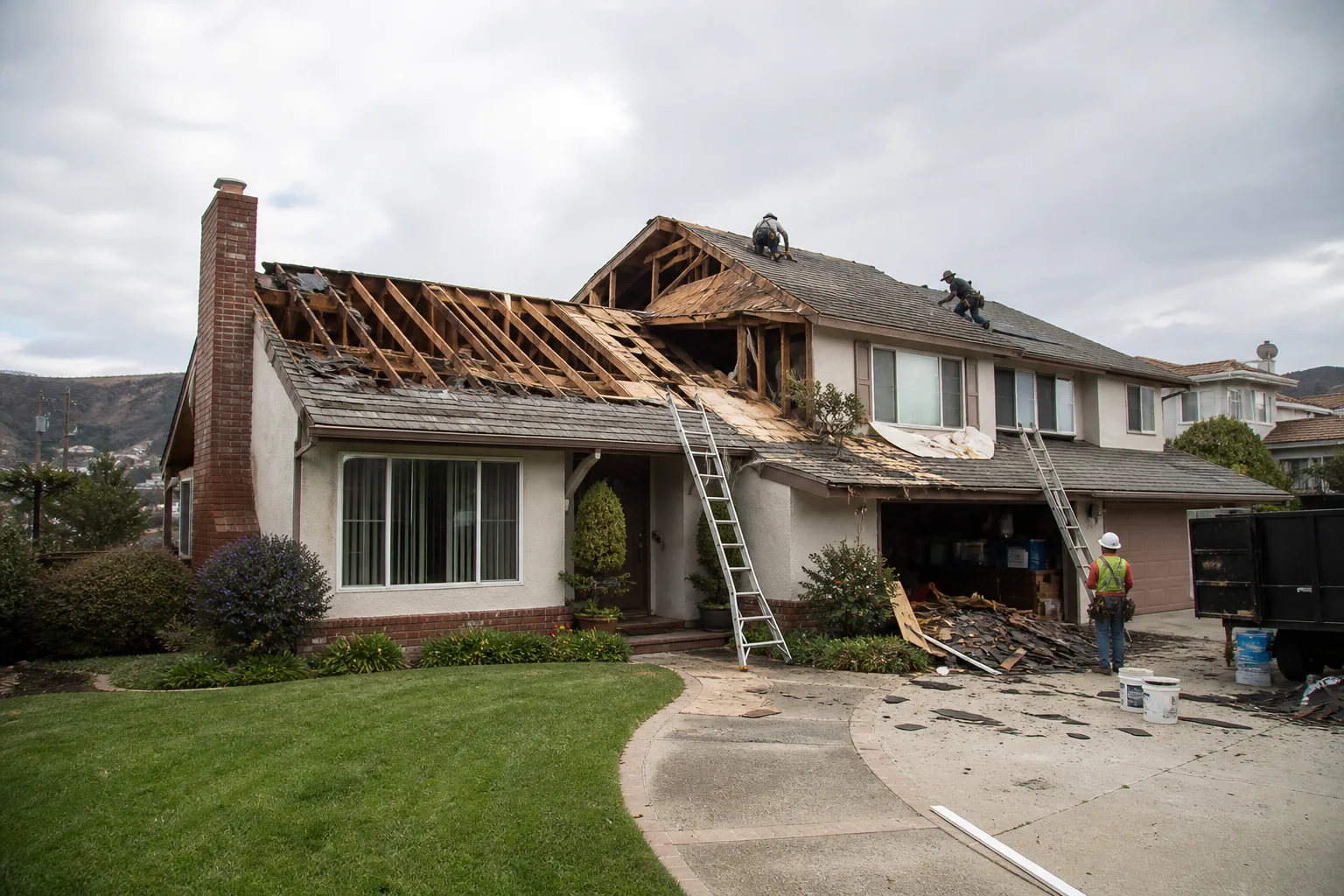
Stabilization work includes tarping a roof, boarding a window, shoring a sagging beam, extracting standing water, and running dehumidifiers. This work needs to happen within hours to prevent compounded damage. It should be done by whoever is licensed and available, and it should be documented thoroughly. This is the kind of work where speed genuinely matters.
Permanent repair work, the actual re-roofing, the foundation piering, the retaining wall reconstruction, should never be rushed. This work requires a proper bid, a written scope, a permit where the San Mateo County building code requires one, and a builder who will stand behind the installation. The contractor who shows up with a tarp and a ladder may not be the contractor you want pouring a new foundation footing or framing a new roof. Those are different skill sets.
We’ve done it both ways. We’ve tarped roofs in the Serramonte area at midnight and had the owner hire a different contractor for the re-roof because they already had a relationship with a roofing specialist. That’s fine. The tarp did its job. Conversely, we’ve walked into homes where a storm-chaser tarped the roof, collected a check, and the owner never saw them again when the permanent repair bid was needed. Know which job you’re hiring for before you sign anything.
Step 4: Recognize the Storm-Chaser Playbook Before You Sign
Within hours of any significant Bay Area wind or rain event, out-of-state crews show up in Daly City with magnet signs on their trucks and a clipboard in hand. Some of these crews are legitimate and do decent work. Others are operating without a California contractor’s license, without workers’ compensation insurance, and without any intention of returning for warranty work. Here are the red flags that should make you set the pen down:
- The deposit demand is 50% or more upfront. California law caps contractor deposits at 10% of the project total or $1,000, whichever is less. Any contractor asking for more is either unlicensed, committing a felony, or both. Walk away.
- The price is good for “today only.” A legitimate contractor’s price is based on the scope and the materials, not on the phase of the moon or the pressure of a clipboard. Refuse any contract with an expiry measured in hours.
- They won’t show you their license. Ask to see the California CSLB license card. Then look the number up on the CSLB website. It takes sixty seconds on your phone. A contractor who hesitates has just answered your question.
- They’re not from the Bay Area. An out-of-state plate isn’t automatically disqualifying, but storm season brings a known population of unlicensed transient crews. A Daly City contractor with local references and a physical address is accountable in a way a crew of unknown origin never will be.
- The contract has an assignment clause. Some storm-chasers sign you, then sell the contract to a different, unknown contractor. Refuse any contract language that allows assignment without your written consent.
This is where the difference between a single-trade specialist and a full-scope Daly City Construction home contractor becomes concrete. A specialist who only does roofing has to sub out the interior water damage repair, the insulation replacement, and the drywall. That means three contractors, three bids, three schedules, and three warranties. A general contractor handles the entire sequence under one license, one contract, and one point of contact. In an emergency, that consolidation of accountability is worth real money.
Step 5: Compress the Post-Emergency Timeline With the Right Contractor
The repair timeline after an emergency is rarely driven by the actual construction. It’s driven by the coordination between the roofer, the water damage contractor, the drywaller, the painter, the electrician, and the flooring installer, each of whom has their own schedule, their own crew availability, and their own idea of what “done” means. The most common delay we see in Daly City is not material procurement. It’s a three-week gap between the roofing crew finishing and the drywaller showing up, because the homeowner was coordinating five separate trades through five separate phones.
A general contractor with a single project manager compresses that timeline by sequencing the trades correctly from day one. The roofer finishes on Tuesday, the water extraction crew is already scheduled for Wednesday, the framing inspection happens Thursday, and the drywallers start the following Monday. The subcontractors work for the GC, not for the homeowner, so the schedule is enforced, not requested.
Permitting is the second compression point. Any general contractor who pulls permits in San Mateo County regularly knows which over-the-counter permits are available, which ones require plan review, and how to phase the work so the permit doesn’t become the bottleneck. A contractor who rarely works in Daly City learns these rhythms on your dime. A contractor who works here every week already has the relationships and knows what the building department will ask for. This applies to emergency work only where permanent repairs trigger permit requirements; the stabilization work itself usually proceeds under the emergency repair exemption, but the permanent repair is where the permit comes in.
When the scope crosses multiple trades, as it often does after a roof failure that has wet out a ceiling, the homeowner also benefits from material choices being consolidated. Instead of a roofer proposing one shingle line and a drywaller proposing whatever’s at the supply house, a full-scope remodeler with a 50-plus brand portfolio can align the roofing system, the insulation, and the drywall assembly to the same standard. That’s not catalog shopping. That’s one standard applied across every trade.
What to Do Right Now, Before the Emergency
The best emergency response is the one you prepared three months ago. Here’s the 20-minute setup that will save you thousands of dollars if something fails:
- Locate and label your shutoffs. Main breaker, main gas valve, main water valve. Take a photo of each and save it in a note on your phone labeled “Emergency.” Write the location of each on a card and tape it inside the front door.
- Buy a moisture meter. Thirty-five dollars. It will tell you whether the water reached the framing, which is the single most expensive unknown in a water damage claim.
- Have a tarp, a roll of flashing tape, and a wet vac. A $50 tarp thrown over a roof breach at hour one prevents tens of thousands in interior damage. You don’t need a contractor to do this. You need to know where the tarp is.
- Read your policy’s mitigation and contractor contact clauses. Some policies require the insurer’s authorization before non-emergency repairs. Emergency stabilization is always allowed; the insurer who penalizes you for throwing a tarp over a hole does not exist. But the line between stabilization and repair is where claims get contested. Know where it is.
- Have a local contractor’s number saved. When the emergency happens, your phone should not be the first time you search “emergency general contractor near me Daly City.” The contractor who knows your house before the emergency is worth more than the best contractor you find during it.
When to call a pro: if the water has reached the electrical panel, if a wall or ceiling is visibly sagging, if the roof structure shows daylight from inside, or if the foundation crack is wider than a quarter-inch and growing. Those are not DIY situations. Call a licensed contractor who carries the right insurance and has the right equipment. Related services in Daly City include our Home Renovation in Daly City work, which often follows emergency stabilization when a full room rebuild is required.
A note on materials, because aftermath matters
When a roof fails and the interior gets wet, the repair choices you make in the rebuild matter as much as the emergency work. We specify entry doors from Therma-Tru and ViewLux when the original door has warped or been damaged, because these doors are engineered for coastal fog and wind exposure, conditions Daly City homeowners know well. For fencing and hardscaping that gets damaged in the same storms, we source from Barrette and Master Halco rather than whatever the nearest big-box store has on the shelf. The cost difference is modest. The lifespan difference is measured in decades. When you’re already paying for an emergency repair, the last thing you want is to do it twice.
The Bottom Line
The first hour of a construction emergency belongs to you, not to any contractor. Shut off the utility in the right order. Photograph everything with scale references and timestamps. Stabilize what needs stabilizing, and then slow way down before you sign anything for the permanent repair. The contractor you choose in hour two will either be the one you hired in hour one because they were the first number you called, or the one you hired in week two because their bid, their license, and their local references all checked out. The second choice costs less almost every time.
If you’re in Daly City and you need help with an emergency stabilization, a post-emergency repair, or a full rebuild, Daly City Construction offers free estimates. Call us at (866) 505-5254. We’ll tell you honestly whether you need us right now, next week, or not at all.
Frequently Asked Questions
You should tarp the breach yourself within the first hour if it’s safe to do so, then call a contractor the same day. The tarp prevents the interior damage from compounding. The contractor appointment can wait a few hours while you document everything and contact your insurer. Stabilization is urgent. Permanent repair is not.
Yes, virtually every homeowner’s policy reimburses reasonable emergency mitigation costs, including roof tarping, water extraction, and dehumidification, provided you document the damage before and during the work. Keep every receipt. Call (866) 505-5254 if you need a contractor who can provide the documentation your adjuster will want to see.
Emergency stabilization work like tarping, boarding, and shoring generally does not require a permit. The permanent repair, like re-roofing, structural repair, or retaining wall reconstruction, usually does. A licensed general contractor who pulls permits in San Mateo County regularly can tell you which applies to your specific project before work begins.
Ask for their California CSLB license number, verify it on the CSLB website, ask to see proof of workers’ compensation insurance, and refuse any contract that demands more than 10% deposit upfront. A legitimate contractor will have no problem with any of these requests. A storm-chaser will start backpedaling.
Written by the team at Daly City Construction, serving Daly City since 2013.
Need Construction Help?
Call Daly City Construction — licensed & insured, here with fast after-hours help in Daly City.
(866) 505-5254